
Dispatch #1
Archival tidbits worth sharing this week:

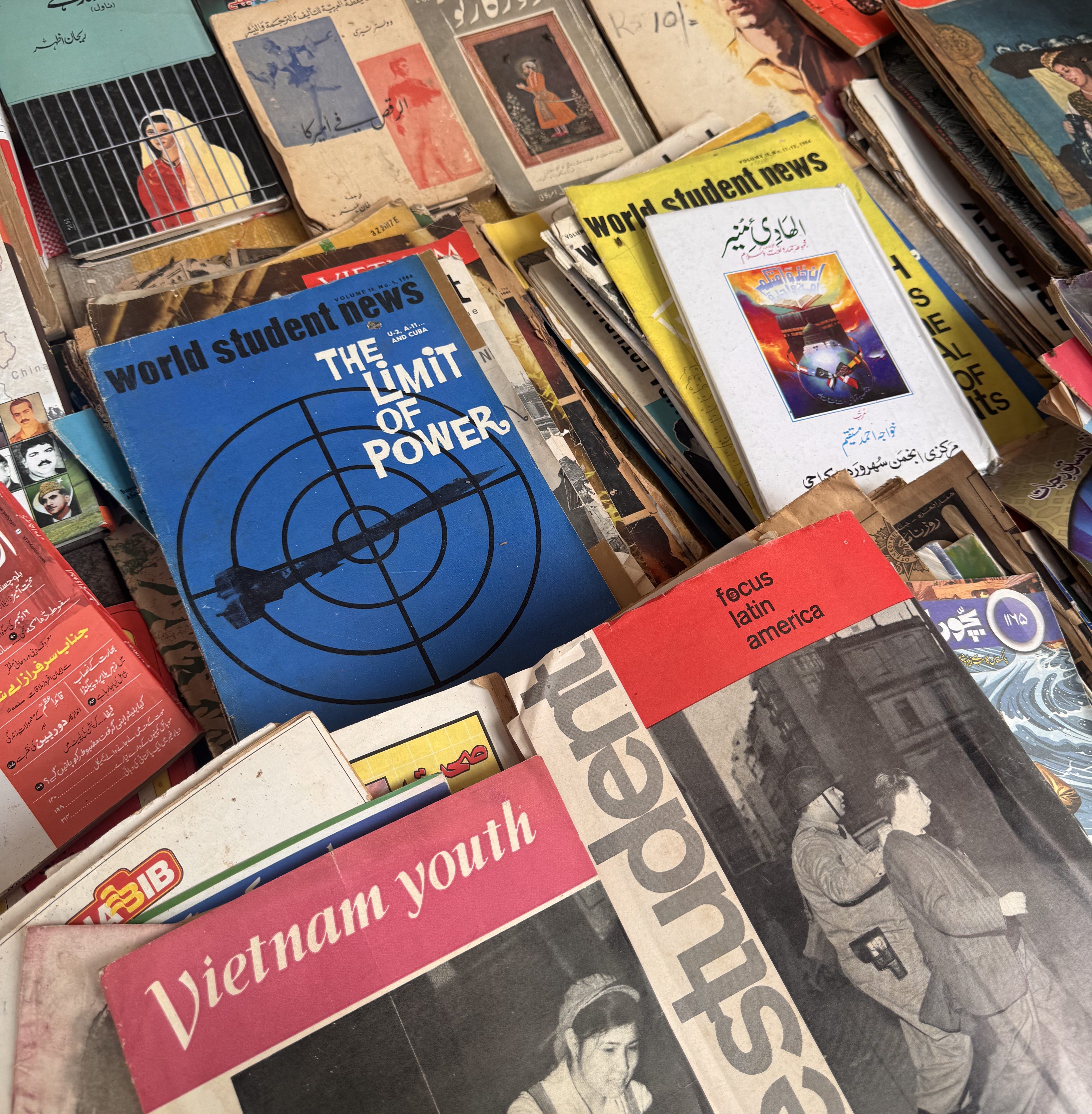
On Bangladesh’s Victory Day, I found myself revisiting this article by Dr. Layli Uddin on Maoism and the Unmaking of Pakistan, which provides insight into the life and work of Maulana Bhashani (who I wrote about in my article about the Toba Tek Singh Kisaan Conference). The article traces the centrality of Islamic Socialism to Bhashani’s thought, and the introduction of new vocabularies intended to ‘impart to the peasant and workers a sense of their own power and dynamism’. I personally love this quote from the article:
“The bay’ah demanded alongside the usual articles of belief in God, Prophet and the spiritual lineage, a belief in socialism. The bay’ah made a Marxist of the murid and a murid out of the Marxist.”
The Caravan recently published a report on the RSS, deeming it the ‘largest far-right network’ in history and shedding light on the Sangh’s organizing and bureaucratic strategy. The article is worth a read, but it also reminded me of Secularizing Islamists: Jama’at-e-Islami and Jama’at-ud-Da’wa in Urban Pakistan (2011) by Humeira Iqtidar. This book traces the development and organization of two prominent right-wing groups in Pakistan and the ways in which they interact with the state. The second chapter of the book, Jamaat-i-Islami Pakistan: Learning from the Opposition, is particularly fascinating. It talks about how the religious right was not only anxious about the growth of the Left, particularly among the younger sections of the population, and its decision to expand its constituencies and political work to include peasant, worker and student communities as a consequence of these anxieties.
A fun little quote from JI propaganda:
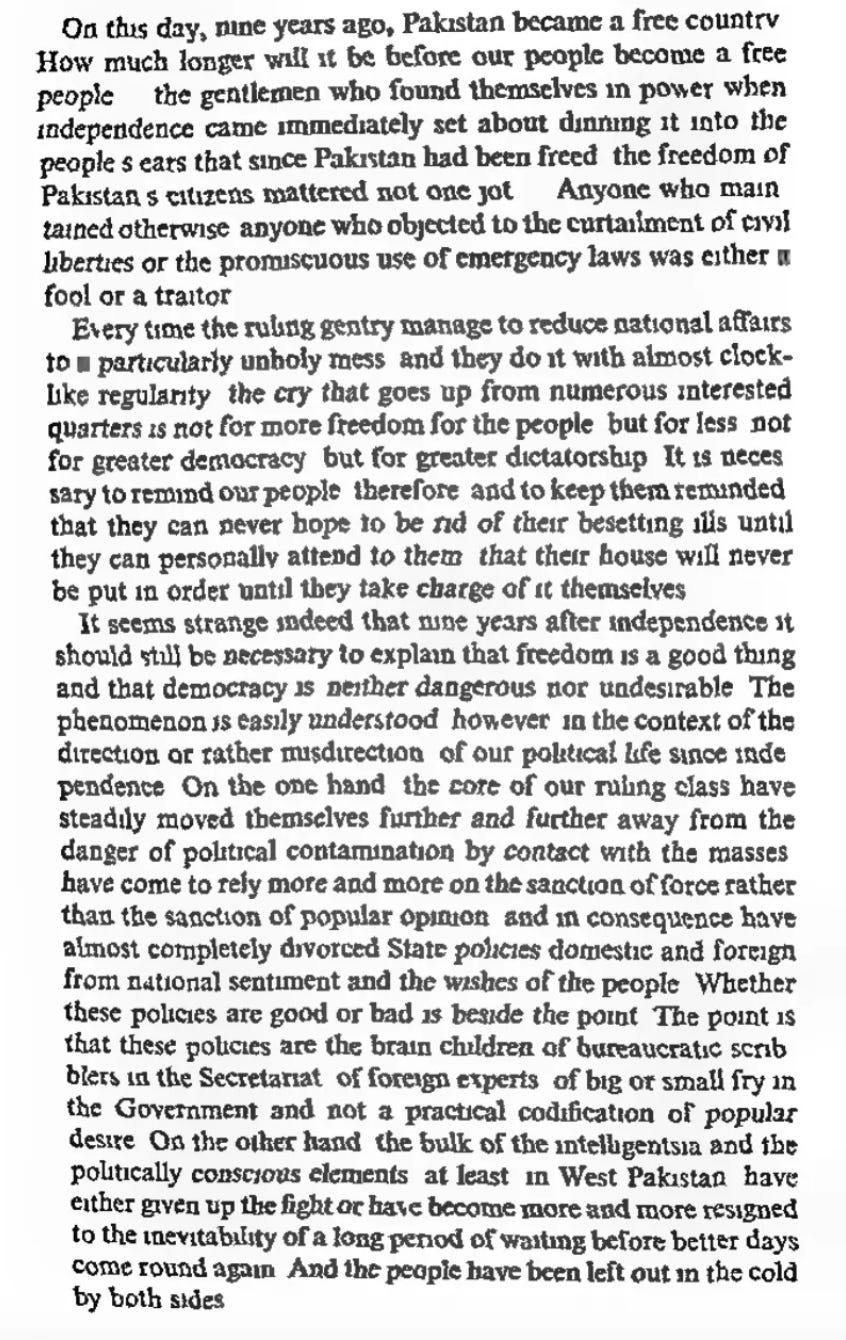
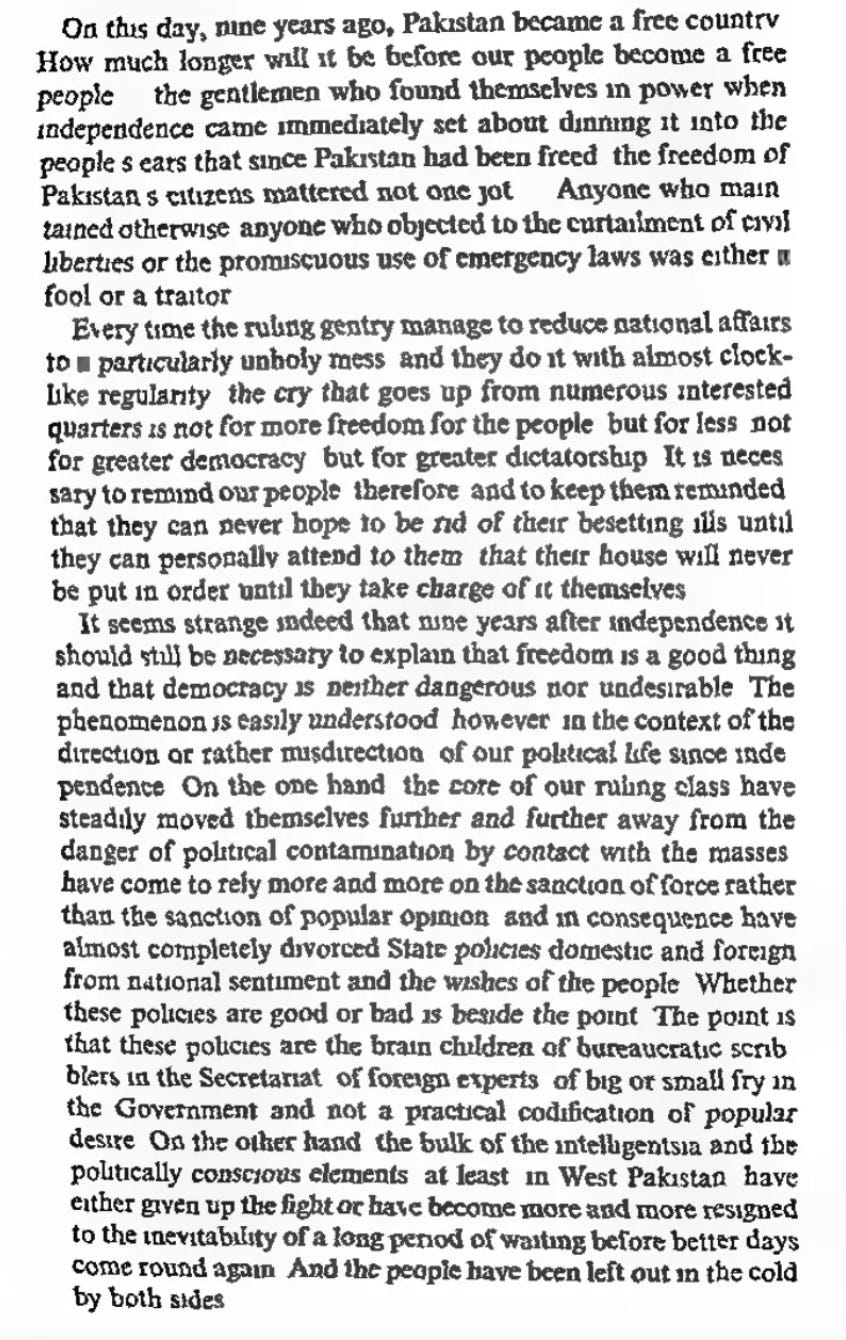
This editorial from the Pakistan Times, originally printed on August 14, 1956 (later republished in Pakistan: Military Rule or People’s Power by Tariq Ali), reads eerily in light of the 27th Amendment, the frivolous case against Imaan Mazari and Hadi Ali Chattha, and the growing political disillusionment as the establishment steadily captures state institutions. Not much has changed:
This podcast by the Socialist Reading Group titled ‘Against Military Rule and Colonial Development with Mir Talpur & Professor Mahvish Ahmad’. Prof. Mahvish Ahmad talks about the significance of reproductive care in how the BYC organizes (starting at the 1:03:40 mark), and how this practice from more masculinist Left spaces in Pakistan and beyond, offering lessons for all of us.
I came across an old copy of Humari Qaumi Saqafat (Our National Culture) by Faiz Ahmad Faiz (ed. Mirza Zafar-ul-Hasan, 1976) in my grandfather’s book collection. Published by Idara-e-Yaadgar-e-Ghalib, Karachi, the book compiles five speeches by Faiz on the topic of Pakistani culture and tradition in Azad Kashmir, at the National College of Arts, Lahore, and for the PTV. As far as I know, no English translation of the lectures currently exist. This may well become a side-project.
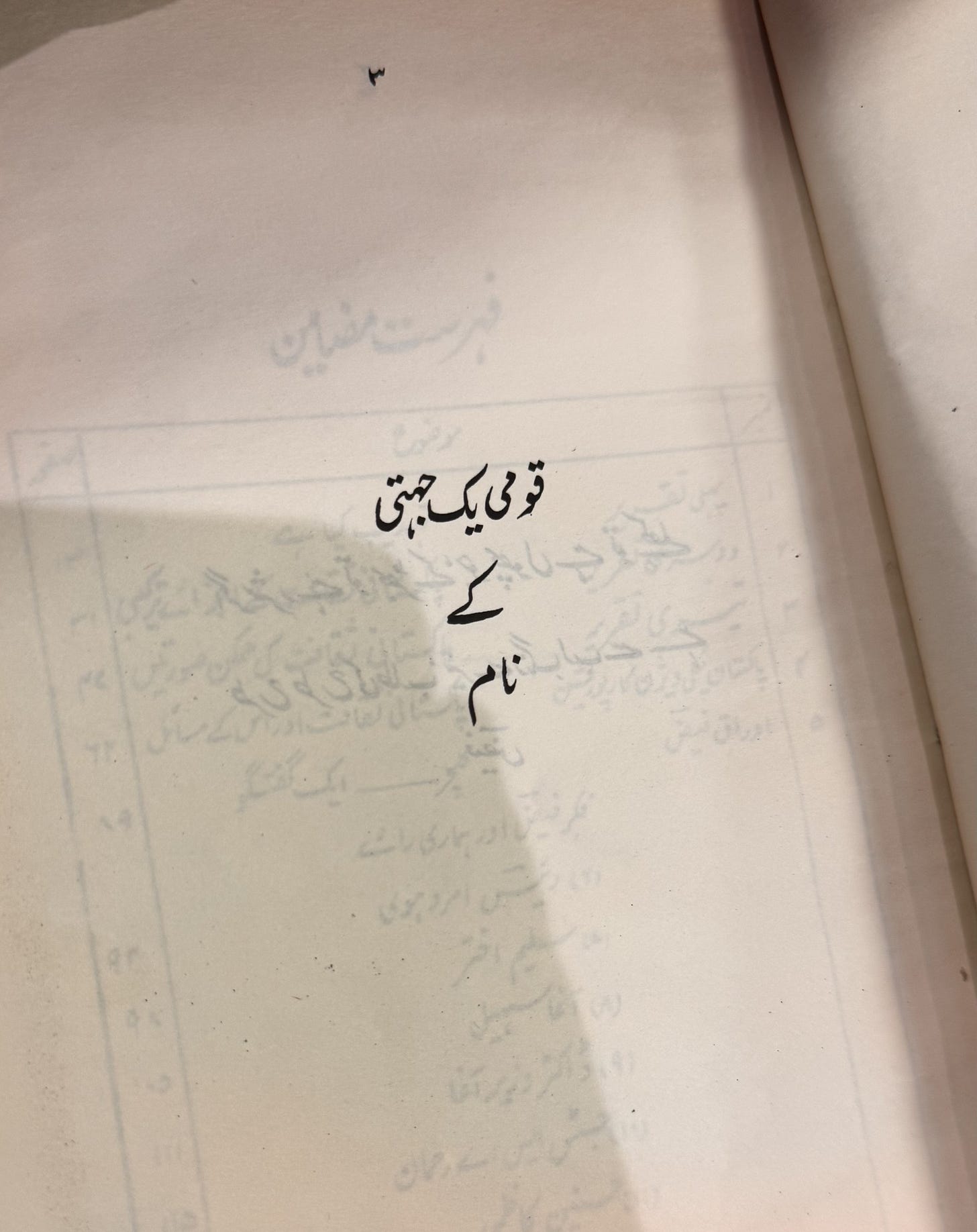
Dedication: ‘For National Unity’

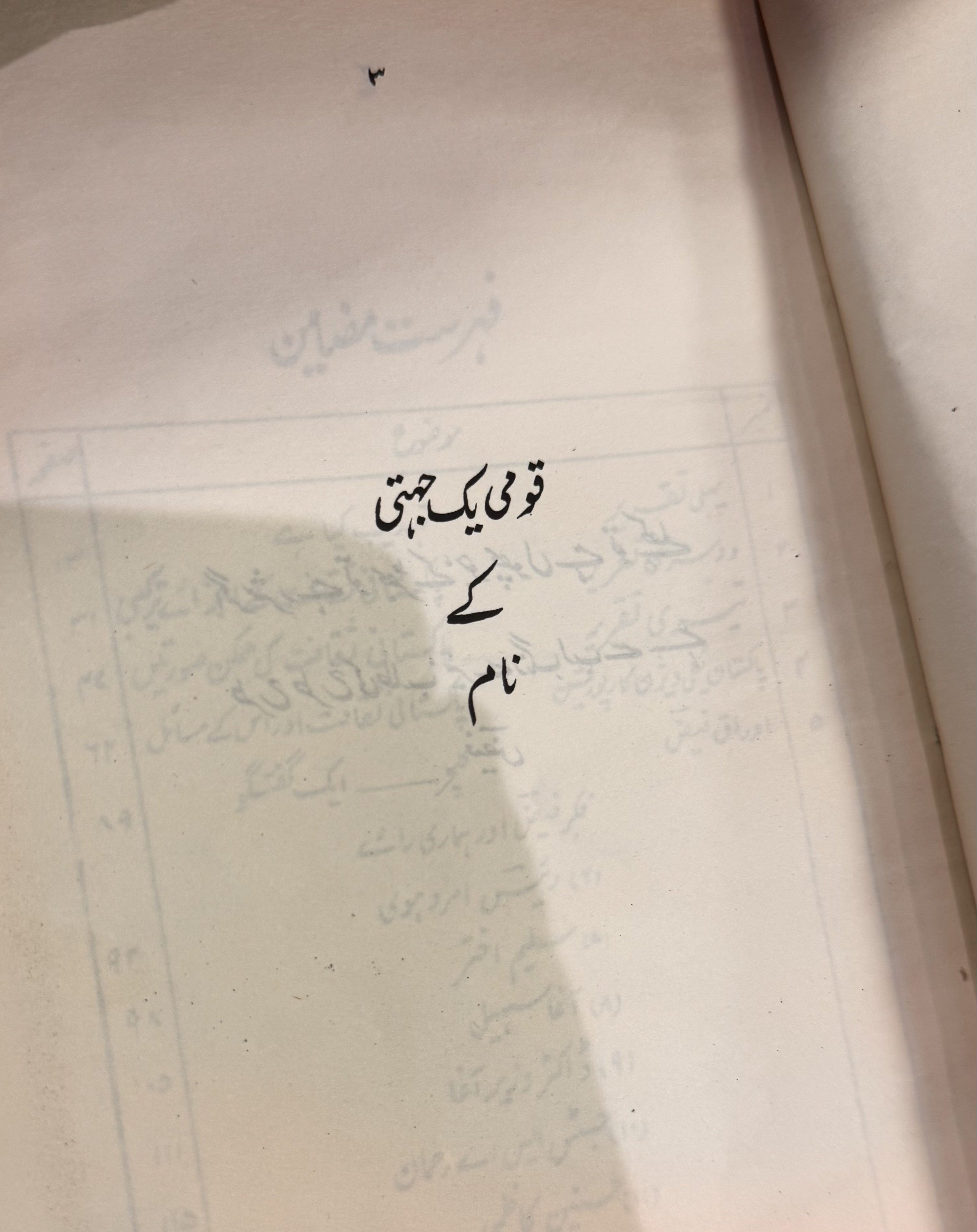
Super coollll
On Faiz:
Have you come across "Faiz, Folk Heritage and Problems of culture" edited by Ahmad Salim and Humaira Ishfaq ( Sang-e-Meel 2013)? I used it to discuss the Faiz Cultural Report in my dissertation on the decline of Hindustani music in Pakistan (recently published as a book by Aks Publications in Lahore).